
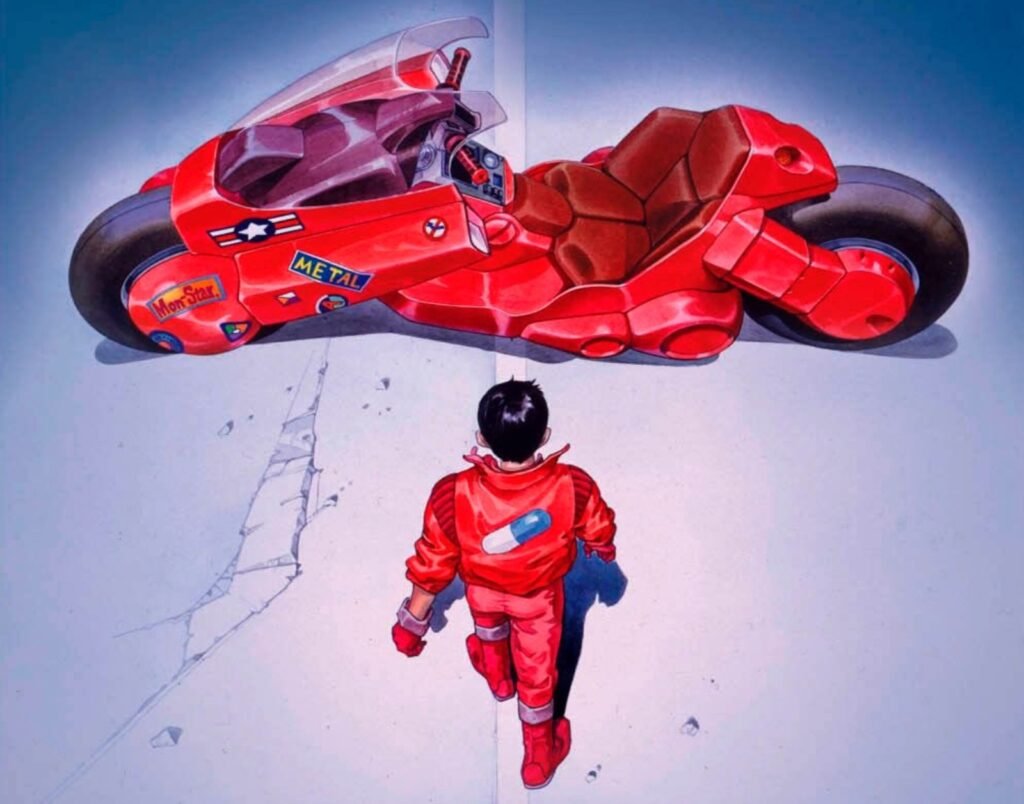
In December of 1982, Katsuhiro Ōtomo—under Kodansha—published the first chapter of Akira. The story of the post-World War III city of Neo-Tokyo in the year 2019, and a teenage biker gang—named bōsōzoku—operating within the city lead by the character Shōtarō Kaneda. Over the course of 120 chapters split over six volumes, one of the gang members named Tetsuo becomes a powerful psychic who constantly leaves destruction wherever he goes, leading to Neo-Tokyo becoming an apocalyptic wasteland the characters are left to survive in. Four years later in 1988, Ōtomo directed a feature film adaptation of his story that broke box office records in both Japan and the USA. Since its release Akira has been hailed as a cultural icon by both critics and general audiences.
The success in the West that Akira achieved was unheard of for an Eastern movie at the time, particularly an animated film. For years Disney had dominated the American animation scene and led the public to believe that animation was a medium for children, that it could not explore dark or violent themes. Akira changed that. During its US cinematic release in 1989, the film grossed $2.2 million at the box office. It was a commercial hit.
“The film was distributed on bootlegged VHS tapes throughout colleges and once American audiences witnessed the film, they were hungry for more anime than ever. Even more exciting than just the beautiful animation or fascinating story; Akira was proof that animation wasn’t just for children.” (Covill)
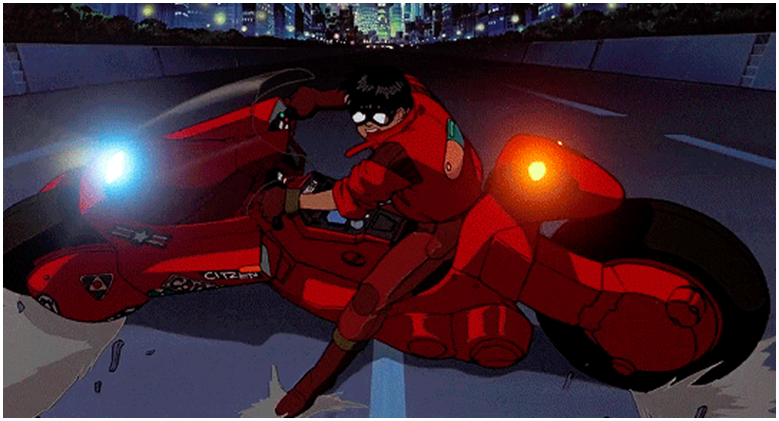
FIG. 1
The visceral violence, dark neon colouring, and cyberpunk aesthetic was unlike anything that Western audiences had seen from animation up until that point. The impact this film had on pop culture can still be felt today through the countless pieces of media that have referenced the film intertextually over the almost 40 years since its initial release. The most common and obvious of these references being to Kaneda’s bike slide from the opening sequence of the film (FIG. 1). The shot has been referenced in almost every piece of media involving a motorbike, from Jordan Peele’s 2022 film NOPE (top right of FIG. 2) to the 2003 Teenage Mutant Ninja Turtles series (middle left of FIG. 2). It is fair to say that Akira is one of if not the most influential piece of anime even today.
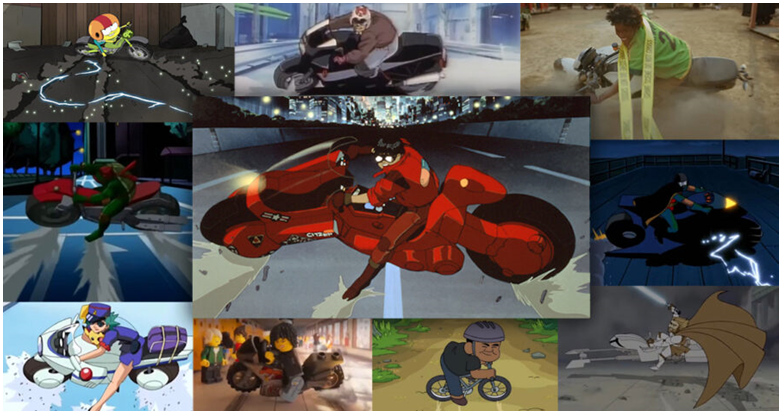
FIG. 2
Due to the manga being 120 chapters long across six volumes, the film condenses the original narrative of the manga considerably. It does so by choosing to adapt the first half of the first volume, the last half of the last volume, and then compress the intermediary chapters into the remainder of the runtime. At times, this does lead to the plot and world of the film feeling underdeveloped. Despite this reorganization of the narrative, it still attempts to explore those same themes, overarching plots, and characters from the manga that have multiple chapters dedicated to them; which ultimately leaves the audience with many loose ends and questions. But the core themes of Akira remain clear throughout the film: mass destruction and the survival that follows.
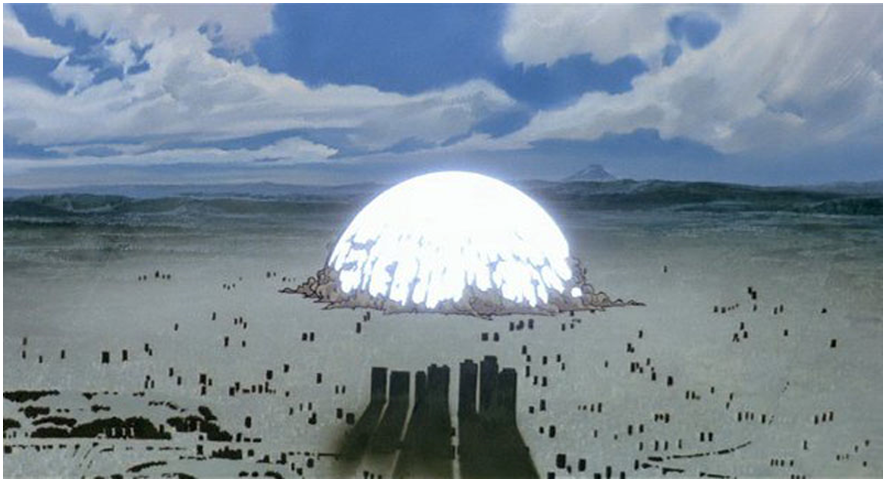
FIG. 3
It is not uncommon to see these themes explored in Japanese media, as they are a direct response to the national trauma of the Japanese people over the Hiroshima and Nagasaki bombings after World War II. It’s hard not to feel the parallels to the tragedy whilst watching the annihilation of Tokyo in the opening scenes of the film (FIG. 3), and many critics and academics have discussed these ideas at length. Bolton goes into great depth in Interpreting Anime on how the cultural anxieties and anger of post-WWII Japan is clearly reflected in the narrative, setting, and characters of Akira. As an example, he states that the character of the Colonel “is easily associated with the militarization in the 1930s that led Japan into World War II, as well as the looming threat of remilitarization that many feared in the postwar.” (29).
But, as explained, these themes have been explored critically countless times and so this essay is going to explore one of the often more overlooked themes that is present in Akira, that of uncontrollable transformation and the terror of living in a body that is no longer your own.
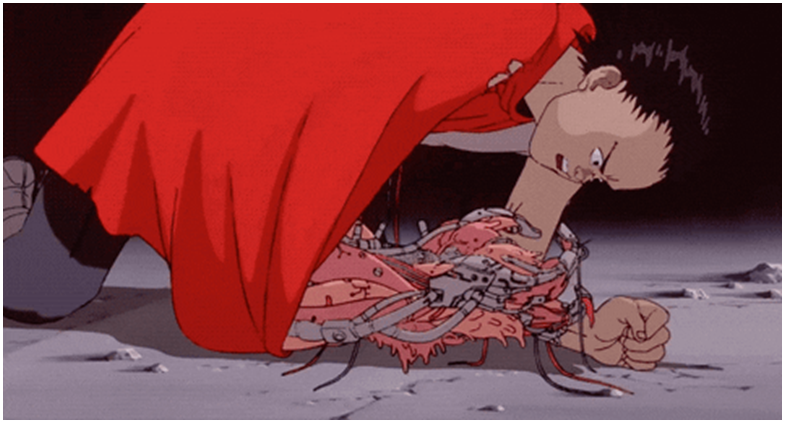
FIG. 4
At around the 1 hour 40 mark of the film Tetsuo begins physically transforming due to his growing psychic abilities, his body seemingly overwhelmed by the power that is now contained within it. After having his right arm cut off during a fight with Kaneda and the Neo-Tokyo military, Tetsuo reforms his arm with his abilities out of scrap metal and wiring from his surroundings, during his transformation these metal components are fused with an ever-expanding mass of Tetsuo’s flesh (FIG. 4). Over the next ten minutes the audience watches as Tetsuo’s body continues to grow in an explosive and grotesque manner (FIG. 5), ripping through the stadium around him as his body contorts uncontrollably. The sequence is violent in a way the rest of the film isn’t, not that the rest of the film is not violent, but Tetsuo’s transformation is uncontrollably violent. No combination of Kaneda or the military’s actions can stop what is happening, and it only ends through the intervention of Akira, a powerful psychic mutant that caused the destruction of Tokyo all those years ago. But Akira does not stop the transformation or return Tetsuo to his human form, they instead take Tetsuo and the other mutants away. Tetsuo’s powers are too much for this world to contain, his final metamorphosis being the physical manifestation of that fact. This is a scene that can only be described as body horror.
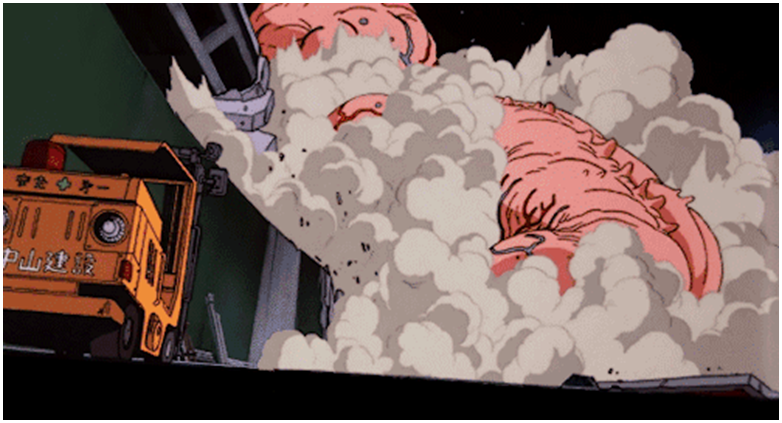
FIG. 5
Xavier Reyes comments that the sub-genre is ‘ill-defined’ but that, “the general understanding seems to be that, if a text generates fear from abnormal states of corporeality, or from an attack upon the body, we might find ourselves in front of an instance of body horror.” (52). Some may argue that body horror is simply another way of labelling a piece of horror media that utilises the ‘gross-out’ or ‘revulsion’ type of scare. Scares that do not give an audience food for thought, but instead simply make them recoil out of disgust for the blood and guts they see on the screen. Stephen King frequently argues that this type of scare is the lowest a horror writer can stoop to and is something to be ashamed of utilizing: “terror on top, horror below it and lowest of all, the gag reflex of revulsion … If I cannot horrify, I’ll go for the gross-out. I’m not proud.” (37)
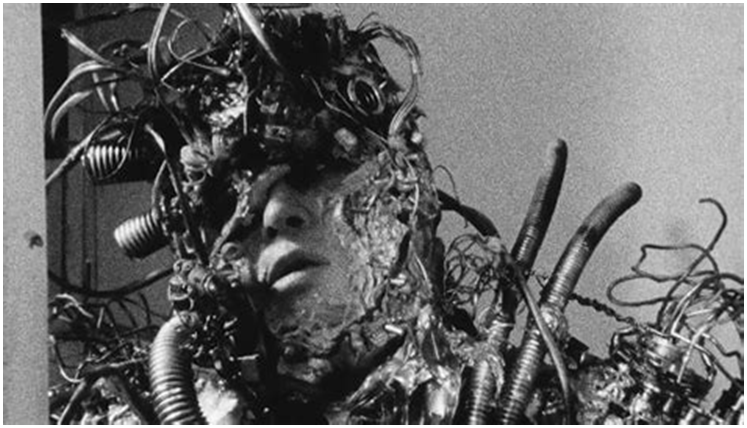
FIG. 6
However, body horror is far more than disgusting contortions of the human body. Where most forms of horror draw from ideas of something terrifying happening due to external forces, whether that be ghosts, monsters, or murderers, body horror seeks to terrify an audience by having the horror be internal, by having the horror come from the human body itself. It’s a much more intimate form of horror and uses of it are often being done for the purposes of symbolism rather than pure ‘gross-out’. For example, Tetsuo (FIG. 6), titled after the character of the same name from Akira, explores ideas of post-industrial Japan and masculinity through a man who steadily transforms to become a mixture of flesh and metal. As another example, the film Naked Blood (FIG. 7) critiques ideas of Japanese censorship and, as McRoy puts it, “the impact of changing gender roles and the emergence of virtual technologies in late capitalist Japanese society.” (110-111).
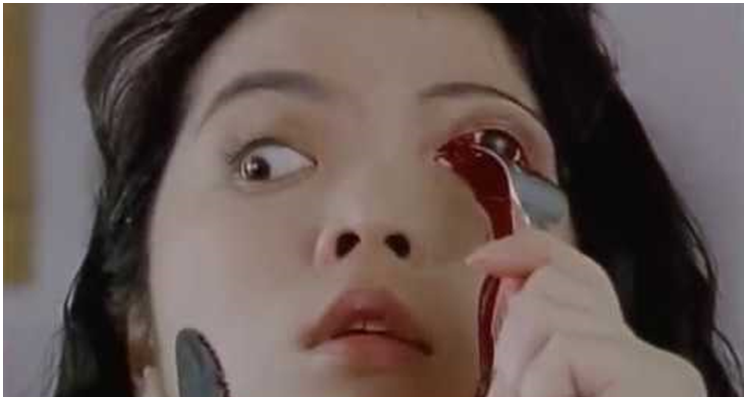
FIG. 7
As Susan Napier notes “what animation can do to the body is one of the most interesting and provocative aspects of the medium … Since movement is at the heart of animation, animation can and does emphasize transformation in a way that simply no other artistic genre is capable of doing.” (35-36), which is one of the reasons that the body horror during Tetsuo’s transformation is so compelling. The other element is that this sequence is ultimately an exploration of the relationship between power, control, and identity. Over the course of the film, Tetsuo believes that the more power he wields the more control he will have over his transformation, but the more powerful he becomes the more he changes and the more alienated he feels from his body and identity. Napier refers to this as an ‘intimate’ apocalypse, and likens the transformation to the shift of being an adolescent to an adult.
Akira is in the end a film about a boy who is changing rapidly, has no control over who he is becoming and despises it, but all he can do is keep moving forward. Even if forward is grotesque and filled with flesh.
Bibliography
Akira. Katsuhiro Ōtomo, Toho, 1988.
Bolton, Christopher. Interpreting Anime. University of Minnesota Press, 2018. JSTOR, https://doi.org/10.5749/j.ctt20fw7d7.5.
Conrich, Ian. “Metal-morphosis: Post-Industrial Crisis and the Tormented Body in the Tetsuo Films.” Japanese Horror Cinema, edited by Jay McRoy, Edinburgh University Press, 2005, pp. 95-106.
Covill, Max. “‘Akira’ is Frequently Cited as Influential. Why is That?” Film School Rejects, 3 Apr. 2017, https://filmschoolrejects.com/akira-influence-12cb6d84c0bc/.
King, Stephen. Danse Macabre. Everest House, 1981.
McRoy, Jay. “Cultural Transformation, Corporeal Prohibitions and Body Horror in Sato Hisayasu’s Naked Blood.” Japanese Horror Cinema, edited by Jay McRoy, Edinburgh University Press, 2005, pp. 107-119.
Napier, Susan. Anime from Akira to Howl’s Moving Castle. Palgrave Macmillan, 2005.
Reyes, Xavier. Body gothic: corporeal transgression in contemporary literature and horror film. University of Wales Press, 2016.
What the Hell Even is Analog Horror Anyways?
Over the past 5 years, if you’ve been on the internet at all, you’ve probably…

Beginner’s Guide to Analog Horror (Where to Start and What to Watch)
So, now that you’ve heard me ramble on through my definition of analog horror you…

Reveiwing Horror Game Demos
I’m a big fan of video games, I’m an even BIGGER fan of buying video…