SPOILERS FOR NBC’S HANNIBAL AHEAD
The NBC television series Hannibal is a horror-thriller show, heavily based on the novels: The Red Dragon and The Silence of the Lambs by Thomas Harris. It centres around the character of Dr Hannibal Lecter, an acclaimed psychiatrist who also just so happens to be a murderous cannibal. The TV series primarily follows the relationship between Lecter and the character of Will Graham. An FBI criminal profiler, who has the capacity for extreme empathy which allows him to enter the mind of the elaborate serial killers he is hunting. One of whom is called the Chesapeake Ripper who, unbeknownst to Will and the other FBI agents, is Hannibal. By the end of the first season Will has been framed for these crimes, and then spends the second season trying to convince those around him of his innocence and Hannibal’s guilt.
Throughout the show, aside from evading arrest, Hannibal’s aims are revealed to be that he wanted to cultivate Will’s murderous tendencies. This was in order to turn Will into a killer like him, so they can understand one another completely, and live the rest of their lives together. By the finale of the show, Hannibal is in custody after turning himself over so that Will will always know where to find him, whilst Will is attempting to catch a killer named The Red Dragon.
Wrath of the Lamb is the finale of Hannibal as a whole. The episode opens with a scene driving forward the Red Dragon plot before quickly moving into a private discussion between Will and Hannibal. They often have exceptionally close private talks together throughout the show, discussing anything from the torment of their psyches to the latest case Will has been placed on. In the case of this particular episode, Hannibal is imagining that they are talking next to one another inside of a church, when in reality Will is visiting him whilst he is imprisoned for his crimes. The two talk about the Red Dragon case and then comes the following sequence of dialogue:
“HANNIBAL: When life becomes maddeningly polite, think about me. Think about me, Will, don’t worry about me.
WILL: You turned yourself in so I would always know where you were. You’d only do that if I rejected you.” (00:12:12-56)
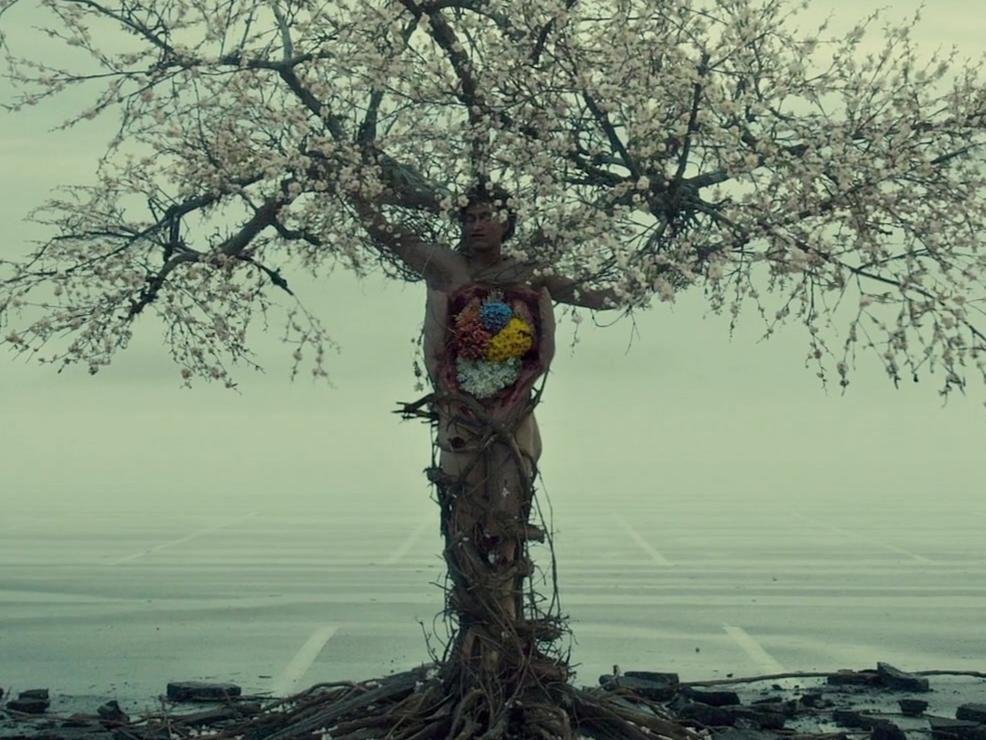
The language used between the two in this segment of dialogue is overly verbose, using phrases like ‘maddeningly polite’. A confession of this nature feels as though it would be more at home in a Shakespeare play than a 2010’s television series. This theatricality is present throughout the show, whether it be through dialogue such as this, or the elaborate murders the killers in the series commit. Such as when Hannibal (S2 E6) intricately wove a corpse into a tree and filled it with flowers that all carried a specific meaning:
“JACK CRAWFORD: The time that he devotes to his work, he really takes pride. Belladonna for the heart. Chain of white oleander for the intestines. Ragwort for the liver.
JIMMY PRICE: These flowers are all poisonous.” (00:07:34-46)
This over-the-top type of theatricality is defined as ‘camp’, “Camp often involves explicit parody, exaggeration, theatricality, irony and humour.” (Barker and Scheele, 104). The concept of a piece of media being camp is inherently queer, due to its basis in playing with and stretching societal norms, so already by its very foundations Hannibal can be viewed as a queer show.
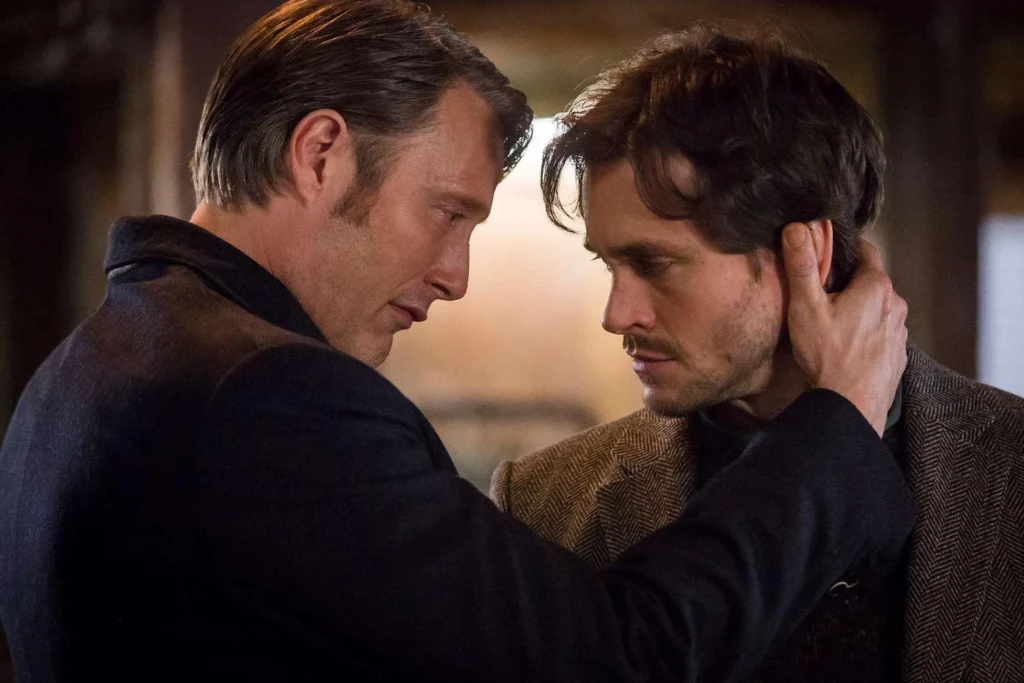
But the relationship between Will and Hannibal can also be read with a queer lens. The above sequence of dialogue is incredibly drawn out through the use of long pauses between each phrase and sometimes each individual word. The volume of both characters is barely above a whisper, as though what they are saying is to be unheard of by anyone but the two of them, even though they are the only ones in the room. Before Will speaks his line, he takes a deep inhale then places his hand on the glass barrier that separates the two. It is hard to tell whether in this moment he simply wants to be physically closer to Hannibal in a tender sense, or whether he has malicious intent behind his action. Maybe it is both. Or Will cannot tell which. Overall, this moment is intimate, and reads more as a conversation between two ex-partners who are still in love, that should be taking place in a romantic film rather than one between bitter rivals in a horror show. So arguably they are both, they are both rivals and in love with one another, this is both a romance and a horror show.
As the episode continues, Will plans to use Hannibal as bait in order to catch the Red Dragon. The plan involves Hannibal being allowed to escape custody in order to lure out the killer. This succeeds, but the killer wants Hannibal to meet him at a secondary location, he goes to leave and Will, in this moment, has the opportunity to abandon Hannibal and likely leave him to die at the hands of the Red Dragon. This is what he has wanted for the past two seasons, for Hannibal to die and no longer be a problem in his life. But Will follows Hannibal without hesitation, and they enter into a confrontation with the killer. Throughout the fight their actions are primal yet practiced and fluid, Will is finally succumbing to the innate murderous tendencies that Hannibal has been cultivating within him.
A key point to note here is how often the ideas of cannibalism and murder are utilised within queer narratives, and understanding why that might be. Gayle Rubin proposed the idea of there being a sex hierarchy that dictates what is societally deemed ‘acceptable’ (the interior ‘charmed circle’) and ‘unacceptable’ (the exterior circle) sex.
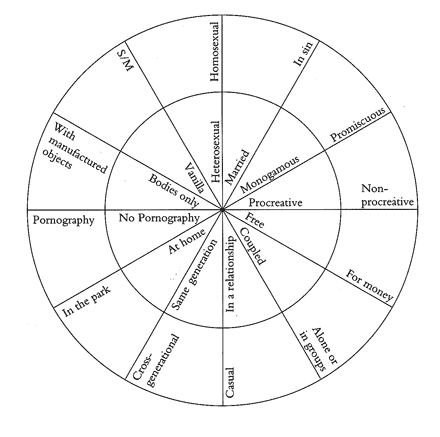
Supposedly, as homosexuality is proposed to be deemed ‘unacceptable’ sex, and therefore deviant, it could be likened to other deviant acts such as cannibalism, a potential explanation for this link between the two ideas. Whilst this could obviously be considered offensive to some, there is an inherent intimacy that portrayals of cannibalism provide due to its direct link to the body. And it can also be argued that this murderous queer concept can be more liberating than oppressive.
After Will and Hannibal succeed in their collaborative murder of the Red Dragon, they hold onto each other on the edge of a cliff.
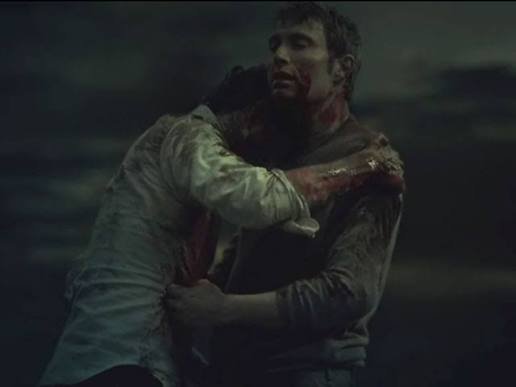
This is once again, an intimate moment between the two, the shots during this scene are primarily close ups of the characters faces looking at each other in a haze of bloodlust, or potentially pure lust for one another.
Will then proceeds to throw them both over the cliff together. Once again, it is unclear if Will is carrying out this action out of a deep love for Hannibal, or out of a want to see his enemy foiled at last. As stated earlier, this episode is the finale of the entire show. There is no indication of whether or not the two survived this fall or if they drowned together, so the lack of a kiss or explicit confession of love from either character across the series surely indicates that this is not a romantic relationship between the two? That would be the case if the idea of clearly defined boundaries between what is queer were in fact real and not just constructs, as ultimately the concept of homosexuality is an invented idea, the act of two people of the same sex being romantically or sexually involved with one another is not. The emotions and relationships in Hannibal, whilst often manipulated and controlled by others, are extremely primal and transgress these boundaries of homo and heterosexual, they simply are what they are. Audiences struggle to understand a relationship such as this one as being queer without these specific labels being placed on it.
Wendy Hsu comments in her analysis of Hedwig and the Angry Inch that “I cannot help but be perplexed and at the same time mesmerised by the disorientating gender and sexuality signifiers of the characters.” (Hsu, 104). Whilst she clearly does not wish any ill will through the comment, Hsu is thinking in very binary terms throughout the essay, focusing on the correctness of the categorisation of these characters rather than simply letting them exist within the text. Whilst some audience members could consider this ‘queerbaiting’, akin to shows such as BBC’s Sherlock or the CW’s Supernatural (A term used to describe fictional media that teases the idea of queer characters or relationships without ever having the intent on following through to gain the viewership of a queer audience, without also alienating non-queer and bigoted audiences in order to gain profit) Will and Hannibal’s feelings for each other are pretty explicitly laid out in episode twelve of season three when Will asks Hannibal’s ex-partner:
“WILL: Is Hannibal… in love with me?” (00:03:16-23)
In summation, much of queer theory exists off of defining ‘queer’ as a verb rather than as a noun. As Barker and Scheele succinctly explain, “Queer is something we do, rather than something we are.” (14). Whilst Hannibal and Will might not be explicitly labelled as queer throughout the show, the way they act and interact with one another throughout the show is most definitively queer.
Bibliography
Barker, Meg-John and Scheele, Julia. Queer; a graphic history. Icon, 2016.
Brown, Jennifer. Cannibalism in Literature and Film. Palgrave Macmillan, 2012.
Holmberg, Carl. Sexualities and Popular Culture. SAGE Publications,1998.
Hsu, Wendy. “Reading and Queering Plato in Hedwig and the Angry Inch.” Queer Popular Culture, edited by Thomas Peele, Palgrave Macmillan, 2007, pp. 103-117.
Rubin, Gayle. “Thinking Sex: Notes for a Radical Theory of the Politics of Sexuality.” The Lesbian and Gay Studies Reader, edited by Henry Abelove and Michéle Barale and David Halperin, 1993, pp. 3-42.
“Futamono.” Hannibal, created by Bryan Fuller, season 2, episode 6, NBC, 4 Apr. 2014.
“The Number of the Beast Is 666.” Hannibal, created by Bryan Fuller, season 3, episode 12, NBC, 20 Aug. 2015.
“Wrath of the Lamb.” Hannibal, created by Bryan Fuller, season 3, episode 13, NBC, 27 Aug. 2015.
Station 3’s Book Launch!
July was a very exciting month for Paw&Claw Ink, although we can’t actually share a…

What the Hell Even is Analog Horror Anyways?
Over the past 5 years, if you’ve been on the internet at all, you’ve probably…
Adam’s Top 10 Magnus Archives Episodes
My History With The Magnus Archives and why I love it so much Fear I…